

The continuous industrial flooring , must satisfy the following minimum features:
- Abrasion resistance.
- Resistance to high temperatures.
- Resistance to the use of chemicals.
- Don’t break.
- Must have flame retardant properties. In the forging and incandescent materials industry, it is almost mandatory flooring.
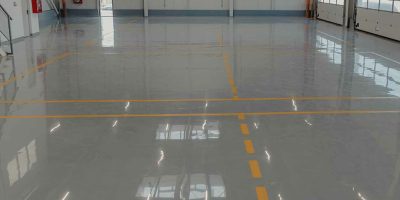
Continuous industrial floors usually combine all of these characteristics. However, there are usually some variants that take advantage of their compatibility with other substances and systems. For example, continuous two-layer resistance flooring is used in production areas and warehouses for its adhesion and high mechanical strength .
They can also be found within the industry, others, such as continuous self-leveling epoxy , used in electronic laboratories and warehouses of flammable material; also that of resin multilayer , characterized by its enormous mechanical resistance, which requires its use in plants and factories where there is a risk of impact or large loads.
And the industrial flooring continues in polished concrete , which respects all the aforesaid characteristics and is perfect also in replacement of the epoxy flooring or any other previously mentioned.
Ultimately, there are many types of continuous industrial flooring , and the use of one or the other will come from the needs and activities of each industrial sector.
A general view on concrete floor types
One of the many advantages of the concrete floor is that it is very versatile. If you’re still in the planning stages of your project,…
How to polish concrete floors

An overview of the basics of polishing and the process step by step As with any other specialized technique, polishing is a multi-step process that…
How to clean polished concrete?

To maintain the floor in polished concrete in good condition, it is to apply a wet cleaning, which must be carried out using chemicals a…